Best Class C RV in 2026: 12 Top Picks Compared for Real Buyers
Posted on January 26, 2026

- What is the best Class C RV?
- Quick picks: “best of” badges (based on measurable criteria)
- How to choose the best Class C RV (before you fall in love with a floorplan)
- The 12 best Class C RVs to consider (2024–2026), with real buyer notes
- Super C models (optional, but they match real search behavior)
- Best Class C RV under 25 feet: the short list
- Best Class C RV for full time living: what matters most
- Best gas mileage RV Class C: how to think about it (without fake MPG promises)
- Cost-effective used options (2015–2021): the smart way to save
- One practical next step (if you own an RV or plan to)
- FAQs
If you’re shopping for the best Class C RV, you’ve probably noticed the problem fast: most “best of” lists don’t tell you the stuff you actually compare when you’re about to spend real money. Floorplan details are vague. Tank sizes are missing. Tow ratings and chassis differences get glossed over. And nobody explains what ownership is like six months in.
This guide is built for RV buyers based on 100,000+ RV travelers and RV owners across North America.
It’s specs forward and focused on what matters: length, sleeping reality, slides, chassis and engine, weights and towing, tanks, storage, price positioning, and the ownership tradeoffs that make one rig feel effortless and another feel like a project.
What is the best Class C RV?
The best Class C RV depends on how you travel, who you're traveling with, and whether you prioritize easy driving, luxury touring, towing power, or full-time livability. For 2026, some of the strongest overall Class C motorhomes include the Winnebago View, Coachmen Cross Trek, Thor Four Winds, Jayco Redhawk, and Jayco Greyhawk because they balance floorplans, sleeping capacity, drivability, storage, and long-term ownership practicality.
Industry demand for Class C motorhomes remains strong, with Class C rigs making up roughly 35% of U.S. motorhome shipments. Many buyers now rent Class C RVs before purchasing to compare layouts and driving experiences in real-world conditions. Platforms like RVezy allow travelers to test multiple Class C floorplans through rentals starting around $150 per night.
Quick picks: “best of” badges (based on measurable criteria)
The rankings are based on a balance of size, livability, tanks, storage, chassis support, and the kind of ownership experience most buyers want.
- Best for families (gas): Jayco Greyhawk 31F
- Best compact gas Class C (under 25 feet): Winnebago Minnie Winnie 22R
- Best small luxury diesel (couples): Tiffin Wayfarer
- Most refined touring diesel layout: Winnebago View/Navion 24T
- Best used-market “easy to find” pick: Coachmen Leprechaun
- Best floorplan variety (gas and diesel lineup): Forest River Sunseeker
- Best bunkhouse-style family layout: Thor Chateau 31E Thor Motor Coach
- Best off-grid “adventure” Class C: Winnebago EKKO
- Best towing-focused Super C: Dynamax Isata 5
- Most luxurious, most spacious Super C: Entegra Coach Accolade XL 37L
- Best small diesel value (premium-leaning): Jayco Melbourne Prestige 24LP
- Best starter Class C that’s common on lots: Coachmen Freelander (dealer specs vary by chassis and floorplan)
How to choose the best Class C RV (before you fall in love with a floorplan)
1) Pick your chassis first: Ford gas vs Sprinter diesel vs Super C truck chassis
This is the part nobody wants to think about until service season.
- Ford E-450 gas (classic Class C): huge service network, generally simpler ownership, good tow capability in many builds. Great if you want a traditional Class C shape with a cabover bed and family-friendly layouts (Greyhawk, Leprechaun, Chateau).
- Mercedes Sprinter diesel (smaller “touring” Class C): often more efficient and refined to drive, but you’re buying into diesel maintenance and a different service ecosystem. Best for couples, road-trippers, and buyers who want a shorter rig that feels easier in towns and parks (Wayfarer, View/Navion, Melbourne Prestige).
- Super C (Ram 5500, Freightliner-style segment): heavier-duty feel, often higher tow ratings and payload, and a “truck” confidence that some buyers want for big trailers or long-haul travel. The tradeoff is cost, size, and sometimes campground fit (Isata 5, Accolade XL).
2) Be honest about “sleeps X”
A manufacturer sleep number is usually “maximum possible humans if everyone is tiny and nobody minds sleeping on converted cushions.”
If you’re buying for:
- Couples: prioritize bathroom layout, storage, and a bed you don’t need to climb over nightly.
- Families: prioritize bunks, dinette usability, and how you live when the slide is in (rest stops matter).
- Full-time living: prioritize tank capacity, insulation and cold-weather capability, and serviceable systems.
3) Decide your comfort boundary on length
A lot of buyers specifically search best Class C RV under 25 feet because it’s a real breakpoint for driveability and campsite flexibility.
- Under ~25 feet: easier parking, simpler trips, fewer “I regret this in town” moments.
- 26–33 feet: the sweet spot for families who want real living space.
- 34–40 feet: getting into “big rig” territory, and you’ll feel it in older parks and tight fuel stations.
Quick checklist: how to choose the right Class C RV
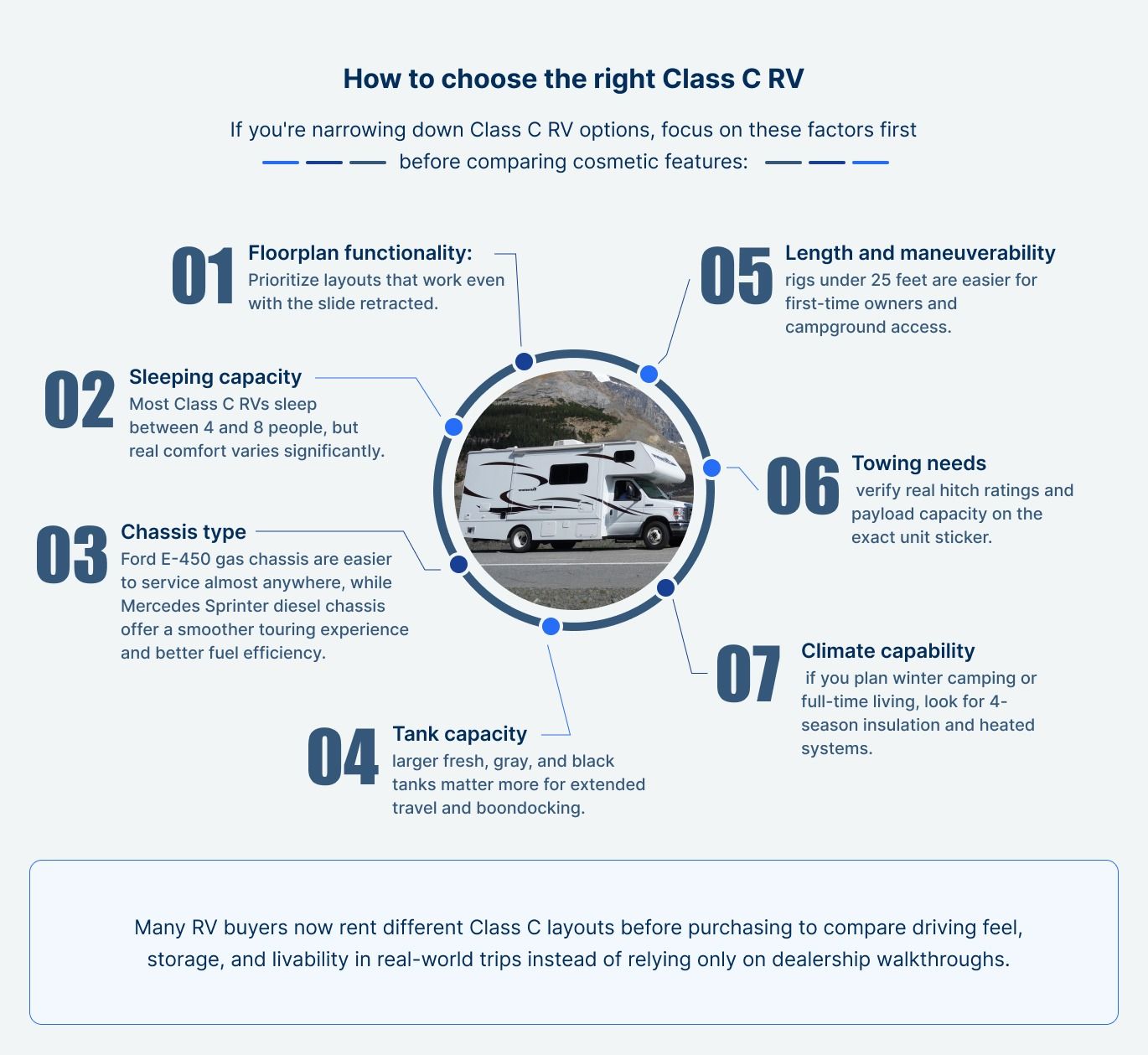
If you're narrowing down Class C RV options, focus on these factors first before comparing cosmetic features:
- Floorplan functionality: prioritize layouts that work even with the slide retracted.
- Sleeping capacity: most Class C RVs sleep between 4 and 8 people, but real comfort varies significantly.
- Chassis type: Ford E-450 gas chassis are easier to service almost anywhere, while Mercedes Sprinter diesel chassis offer a smoother touring experience and better fuel efficiency.
- Tank capacity: larger fresh, gray, and black tanks matter more for extended travel and boondocking.
- Length and maneuverability: rigs under 25 feet are easier for first-time owners and campground access.
- Towing needs: verify real hitch ratings and payload capacity on the exact unit sticker.
- Climate capability: if you plan winter camping or full-time living, look for 4-season insulation and heated systems.
Many RV buyers now rent different Class C layouts before purchasing to compare driving feel, storage, and livability in real-world trips instead of relying only on dealership walkthroughs.
The 12 best Class C RVs to consider (2024–2026), with real buyer notes
1) Jayco Greyhawk 31F (Gas, Ford E-450)
Why it's good: It’s a classic “do-it-all” family Class C with the mainstream feature set buyers expect, plus a chassis that’s easy to service almost anywhere.
Basics
- Chassis/engine: Ford E-450 with 7.3L V8 listed on Jayco’s spec page
- Length: Jayco lists the 31F at about 32 feet 7 inches on the 2026 page
- Hitch/towing: Jayco lists a 7,500 lb hitch rating on the 31F page (confirm on your exact build sticker)
Livability
Greyhawk is a strong fit if you want a true family layout: multiple sleeping zones, a real kitchen, and a living area that doesn’t feel like you’re camping in a hallway. It’s also a good candidate if you want a Class C that still feels “traditional,” meaning a cabover bunk and straightforward systems.
Tanks and trip style
Depending on model year and published spec sources, you’ll often see tank capacities around 47 fresh, 41 gray, 31 black for this floorplan in the wild. Use that as a directional anchor, then confirm the exact unit you’re buying.
Ownership pain points to think about
- Slides add space, but they also add seals, motors, and alignment issues over time. If you’ll store outdoors, you want a consistent maintenance routine.
- Big family floorplans get used hard. Look closely at dinette hardware, cabinet hinges, and how the bathroom door lines up when the coach flexes.
Badge fit: Best for Families, Most Popular Gas Class C
Manufacturer: Jayco
2) Winnebago Minnie Winnie 22R (Gas, compact, under 25 feet)
Why it's good: If your top priority is “easy to own,” a compact, no-slide Class C is hard to beat. The 22R is a clean example of why smaller rigs are often the smartest first buy.
Basics
- Length: 23'10"
- Tanks: 40 fresh / 24 gray / 21 black
- Storage: 60.4 cu ft listed
- Fuel capacity: 55 gallons listed
Livability
For a couple, a small family, or a solo traveler, this is the kind of rig that gets used a lot because it’s not intimidating. You can run errands, fit in more campsites, and handle fuel stops with less stress.
Ownership pain points
- No-slide rigs have fewer things to break, but you need to be comfortable with a narrower living space.
- Smaller tanks mean you’ll think about water sooner if you boondock.
Badge fit: Best Compact, Best Easy-to-Own, Best Class C RV Under 25 Feet
Manufacturer: Winnebago
3) Tiffin Wayfarer (Diesel, Mercedes Sprinter)
Why it's good: When buyers are looking for the best Class C RV, they’re often asking about build feel and long-term satisfaction, not just specs. The Wayfarer is a premium small diesel option built on a Mercedes cutaway chassis.
Basics
- Chassis: Mercedes-Benz cutaway (Tiffin lists 3500XD as standard on the Wayfarer line)
- Length: 25'8"
- Sleeps: Tiffin positions it as 2 to 4 depending on configuration
Livability
This is a strong “couples touring” rig: shorter length, more refined driving feel, and an interior package that aims at comfort over maximum sleeping count.
Ownership notes
- Sprinter-based rigs can be great, but be intentional about where you’ll service it. If you travel far from metro areas, plan ahead for appointments.
- Diesel adds cost (maintenance and consumables), but many buyers accept it for driving comfort and efficiency.
Badge fit: Best Small Luxury Diesel, Best for Couples
Manufacturer: Tiffin Motorhomes
4) Winnebago View/Navion 24T (Diesel, Sprinter)
Why it's good: It’s one of the most recognizable touring Class C names, and Winnebago publishes unusually clear spec data.
Basics
- Length: 25'8"
- Storage: 80.9 cu ft
- Tanks: 30 fresh / 46 gray / 47 black
- Fuel capacity: 24.5 gallons listed
Why buyers like it
That storage figure is a big deal for a smaller diesel Class C. And the holding tank numbers (especially gray/black) can make it feel more “trip capable” than you’d expect for its size.
Ownership notes
- Touring diesels can be “less forgiving” with weight. Pay attention to cargo capacity, and don’t assume you can load it like a big gas Class C.
- If you like winter camping, confirm tank heating and insulation details on the exact model year you’re buying (these packages change).
Badge fit: Most Refined Touring Layout, Best Storage (Small Diesel)
Manufacturer: Winnebago
5) Coachmen Leprechaun (Gas, Ford E-450, example: 319MB)
Why it's good: If you’re shopping value and want lots of used inventory, Leprechaun keeps showing up for a reason. It’s a mainstream gas Class C with many floorplans and published specs.
Basics (319MB example)
- Chassis: Ford E-450
- Length: 32'11"
- GVWR: 14,500 lb
- Fuel capacity: 55 gal
- Tanks (varies slightly by spec page/version): around 50 fresh and low-30s gray/black listed
Why it’s great for used buyers
You can often find multiple years, multiple layouts, and a ton of dealership familiarity. That matters when you’re getting repairs or sourcing parts.
Ownership notes
- Big-volume lines can be a win for parts and knowledge base, but you still need a careful pre-delivery inspection or a thorough used inspection. Water intrusion is the number one thing to rule out.
Badge fit: Best Used Market Pick, Best Traditional Layouts
Manufacturer: Coachmen
6) Forest River Sunseeker (Gas and MBS diesel lineup)
Why it's good: Some buyers don’t start with one floorplan. They start with “I want Sunseeker because there are so many options.” That’s a valid strategy if you want to compare a wide lineup without learning 15 brands.
Basics
Forest River’s Sunseeker lineup includes gas Class C models and the Sunseeker MBS (Mercedes diesel) models, with at least one MBS floorplan showing around 25'5" length and diesel fuel capacity listed.
Why it’s useful
If you’re trying to find:
- A high-sleeper layout
- A shorter diesel touring rig
- A traditional family Class C
Sunseeker gives you a lot of permutations without leaving the lineup.
Ownership notes
- With big lineups, specs vary a lot. Don’t generalize tank sizes or tow ratings across “Sunseeker” as a whole.
Badge fit: Best Floorplan Variety
Manufacturer: Forest River
7) Thor Chateau 31E (Gas, Ford, bunkhouse-style)
Why it's good: If you’re shopping family bunkhouse layouts, you want at least one “classic bunkhouse Class C” in the comparison set, and the Chateau 31E fits that archetype.
Basics
Thor’s floorplan page lists the 31E at 32'8" length and 14,500 lb GVWR, with Ford chassis noted.
Family livability
Bunkhouse-style Class C rigs tend to work because kids get their own zone, and adults keep the primary sleeping area intact. It’s not just about sleeping count. It’s about keeping the dinette usable.
Ownership notes
- Bunks and cabover areas are common water intrusion zones if seals are neglected. On any bunkhouse Class C, inspect roof transitions and window seals carefully.
Badge fit: Best Bunkhouse, Best for Big Groups
Manufacturer: Thor Motor Coach
8) Winnebago EKKO (Adventure-leaning Class C)
Why it's good: Even if you’re shopping “traditional” Class C, the EKKO comes up constantly because it targets a different intent: AWD capability and off-grid readiness in a Class C footprint.
Basics
Winnebago positions the EKKO as blending camper van efficiency with Class C capacity, and highlights AWD capability. The manufacturer page also shows a starting at price (useful as a positioning anchor).
Who it’s for
- Buyers who prioritize trailheads, shoulder-season travel, and “get out there” capability
- People who don’t want a massive Super C but want more than a van
Ownership notes
- “Off-grid” rigs still need water planning. Bigger batteries don’t solve small tanks.
- Specialty systems can mean more specialized service.
Badge fit: Best Off-Grid, Best Adventure Rig
Manufacturer: Winnebago
9) Jayco Melbourne Prestige 24LP (Small diesel)
Why it's good: It’s another strong small diesel Class C option for buyers who want a premium feel without jumping to a much longer coach.
Basics
Jayco publishes Melbourne Prestige model pages by year, with the 24LP in the lineup and diesel positioning on Mercedes chassis.
Livability
This is a “touring comfort” choice. The trick with smaller diesels is finding the floorplan that feels open enough day to day without relying on constant outdoor living.
Ownership notes
- Confirm the exact tank sizes and cargo capacity for the year you’re buying. These can swing meaningfully even within the same model name.
Badge fit: Best Small Diesel Value (Premium Leaning), Best for Couples (Diesel)
Manufacturer: Jayco
10) Coachmen Freelander (Starter-friendly, common on lots)
Why it's good: If your goal is to buy your first Class C without hunting forever, you want at least one “high availability” model line that shows up across dealers and years.
Example spec anchor (21RSS on Chevy 4500)
A dealer listing shows an example Freelander 21RSS on a Chevy 4500 chassis at 24'9" length with 43 fresh / 28 gray / 31 black in that specific build.
Why it’s worth considering
- Easier to find
- Easier to compare across multiple units on the lot
- Often a strong “value per dollar” play if the condition and inspection check out
Badge fit: Best Starter Class C, Best Availability
Manufacturer line: Coachmen
Super C models (optional, but they match real search behavior)
Some buyers searching “best Class C RV” are really asking: “Should I just buy a Super C?”
If you tow heavy, travel long distances often, or want a more truck-like chassis feel, these two are worth comparing.
11) Dynamax Isata 5 (Super C diesel, towing-focused)
Why it's good: Dynamax positions the Isata 5 around heavy-duty capability, including a Cummins diesel and a factory 4WD chassis option in the lineup.
Basics (manufacturer positioning)
- Chassis: Ram 5500 stated
- Engine: Cummins 6.7L diesel listed
- Tow rating: trailer hitch listed at 10,000 lb with 750 lb tongue stated
Who it’s for
- You tow a serious trailer
- You want a heavier-duty feel than a traditional Class C
- You want more payload headroom (still confirm real sticker payload)
Badge fit: Best Towing-Focused Super C
Manufacturer: Dynamax RV
12) Entegra Coach Accolade XL 37L (Super C diesel luxury)
Why it's good: If you want the best Class C RV for full time living, bigger Super C rigs often enter the chat because they offer more systems capacity, more storage, and a more residential feel.
Basics (37L)
- Exterior length: 39'4"
- GVWR: 31,000 lb
- Fuel capacity: 100 gallons listed
- Fresh water: 72 gallons listed
Full-time living reality
This is the kind of rig that can feel dramatically more comfortable for long stays. The tradeoff is obvious: it’s longer, more expensive, and you’ll plan routes and campgrounds more carefully.
Badge fit: Most Luxurious, Most Spacious (Super C)
Manufacturer: Entegra Coach
Best Class C RV under 25 feet: the short list
If you’re specifically searching best Class C RV under 25 feet, you’re optimizing for simplicity: easier driving, easier campsites, fewer regrets.
Two of the most relevant in this guide:
- Winnebago Minnie Winnie 22R (23'10")
- Coachmen Freelander examples around the mid-24 foot range exist depending on floorplan and chassis (verify exact unit)
Best Class C RV for full time living: what matters most
If you’re buying to live in it, “best” becomes less about brand and more about systems and layout.
Prioritize:
- Tank capacity and dump frequency: fresh, gray, and black tanks determine how often you move.
- Bathroom layout: dry bath vs wet bath, and whether someone can use it while another cooks.
- Bed access: if you have to crawl over each other nightly, it gets old fast.
- Storage and payload: full-time gear adds up quickly.
- Serviceability: you’ll need parts and appointments. Choose a chassis you can realistically service where you travel.
From the models above, full-time buyers often gravitate toward:
- Larger gas Class C family layouts like Greyhawk or Leprechaun for space and service network
- Super C luxury like Accolade XL if budget and campground fit allow
Best gas mileage RV Class C: how to think about it (without fake MPG promises)
People search best gas mileage RV Class C, but MPG varies wildly based on speed, wind, load, tire pressure, elevation, and even how much water you carry.
A more honest approach:
- If you want better efficiency and a more “car-like” drive, look at shorter Sprinter-based diesel touring Class C rigs (Wayfarer, View/Navion, Melbourne Prestige).
- If you want simpler ownership and easier service access, a gas Ford E-450 Class C can still be the “best” choice even if it burns more fuel, because the total ownership experience is easier for many buyers.
If you want, I can help you build a “fuel cost reality check” section using a range of realistic annual miles and average fuel prices, without pretending there’s a single magic MPG number.
Cost-effective used options (2015–2021): the smart way to save
If you want the best Class C RV brands without paying 2024–2026 prices, the used sweet spot is often 2015–2021 because:
- inventory is deeper,
- depreciation has already done some work,
- and there’s enough modern design and safety tech to feel current.
Used-friendly lines (easy to find, lots of community knowledge):
- Winnebago Minnie Winnie / Spirit
- Winnebago View/Navion
- Jayco Redhawk / Greyhawk
- Coachmen Leprechaun / Freelander
- Forest River Sunseeker
Used inspection tip (non-negotiable): water intrusion and delamination checks matter more than floorplan excitement. A pretty interior can hide expensive problems.
One practical next step (if you own an RV or plan to)
If you already own an RV and you’re weighing what it costs to keep, store, and maintain it, it can be helpful to see the other side of ownership too: what typical guests look for, and which features hold value.
Want to know how your RV can make money when you're not using it? Learn more!
FAQs
What is the best Class C RV?
Some of the best Class C RVs in 2026 include the Winnebago View, Jayco Redhawk, Coachmen Cross Trek, and Thor Four Winds. These models are popular for their floorplans, drivability, storage, and sleeping capacity. Class C rigs make up roughly 35% of U.S. motorhome shipments.
What is the best Class C motorhome for full-time living?
The Jayco Redhawk and Winnebago View are popular Class C motorhomes for full-time living because they offer larger water tanks, better storage, and stronger 4-season insulation. Many full-time RV travelers prioritize livability, tank capacity, and serviceability over luxury features.
How do I choose a Class C RV?
Choose a Class C RV based on floorplan, sleeping capacity, chassis type, and travel style. Most Class C rigs sleep 4–8 people and are built on Ford or Mercedes chassis. Buyers should also compare tank sizes, towing capability, storage, and overall length before purchasing.
What is a Class C motorhome?
A Class C motorhome is an RV built on a van or truck chassis with a distinctive over-cab sleeping area. Most Class C RVs are 20–33 feet long and sleep 4–8 people. They are popular because they balance drivability, storage, and family-friendly living space.

Team RVezy
Team RVezy is a group of RV enthusiasts who traverse the U.S. and Canada in our campervans, tiny trailers, and motorhomes. We love the open road and the feeling of having nowhere to go but everywhere.
View more posts