Slab City, California: visiting the Last Free Place
Posted on October 16, 2026
In 1942 the Marine Corps built Camp Dunlap in the desert east of the Salton Sea and trained artillery units there through the Second World War. By 1956 the buildings were gone. What stayed behind were the concrete foundation slabs, and the slabs gave the place its next life and its name.
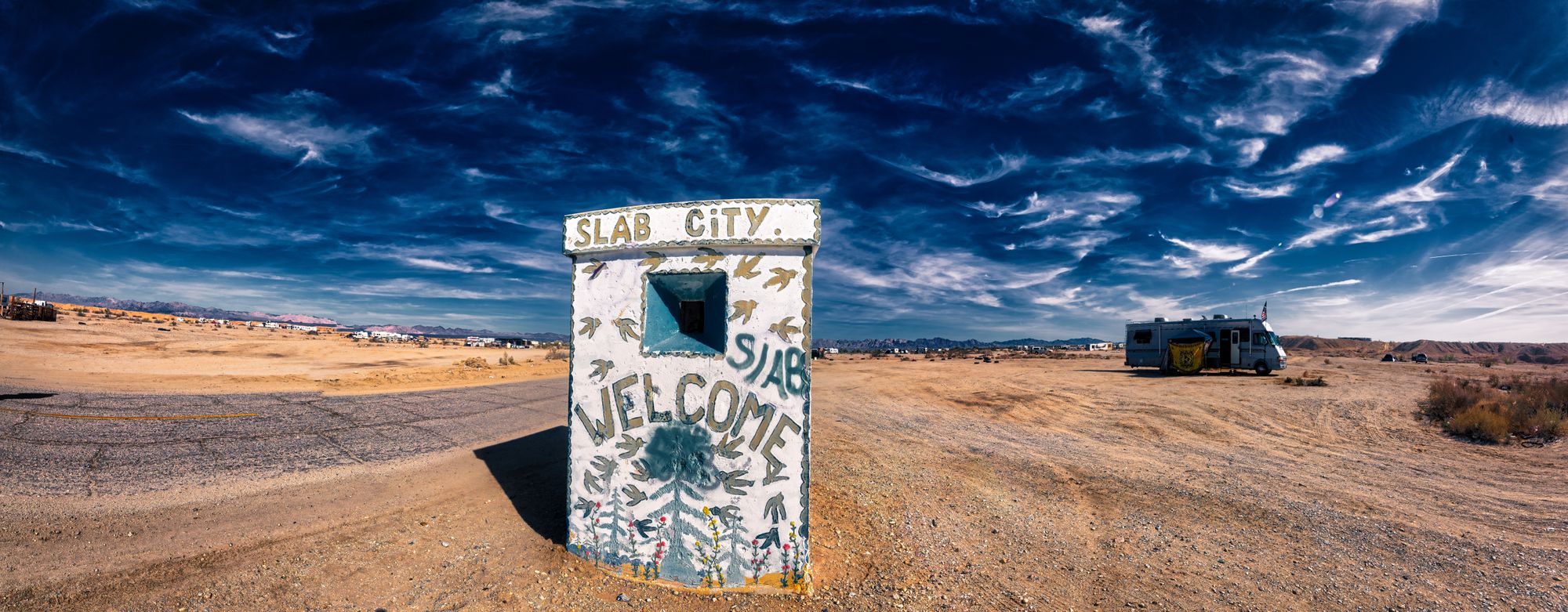
Slab City is what grew on those foundations: an off-grid community on state land near Niland, California, with no rent, no power lines, no running water, no sewage service, and no trash pickup. Residents call it the Last Free Place. A few hundred people, by most counts around 150, stay through summers that run past 110 degrees. Every winter, snowbirds and van travellers swell the population into the thousands.
What there is to see
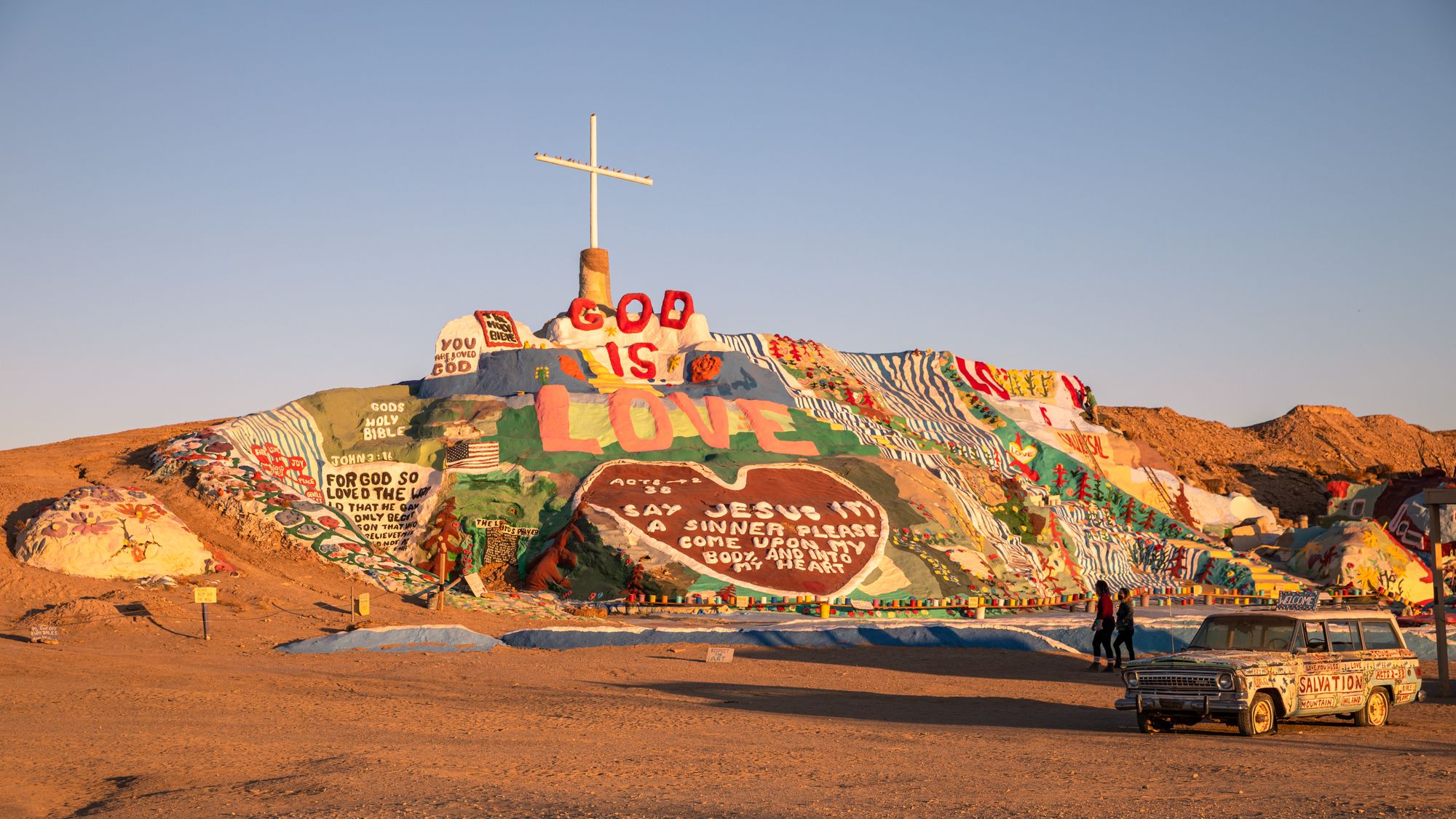
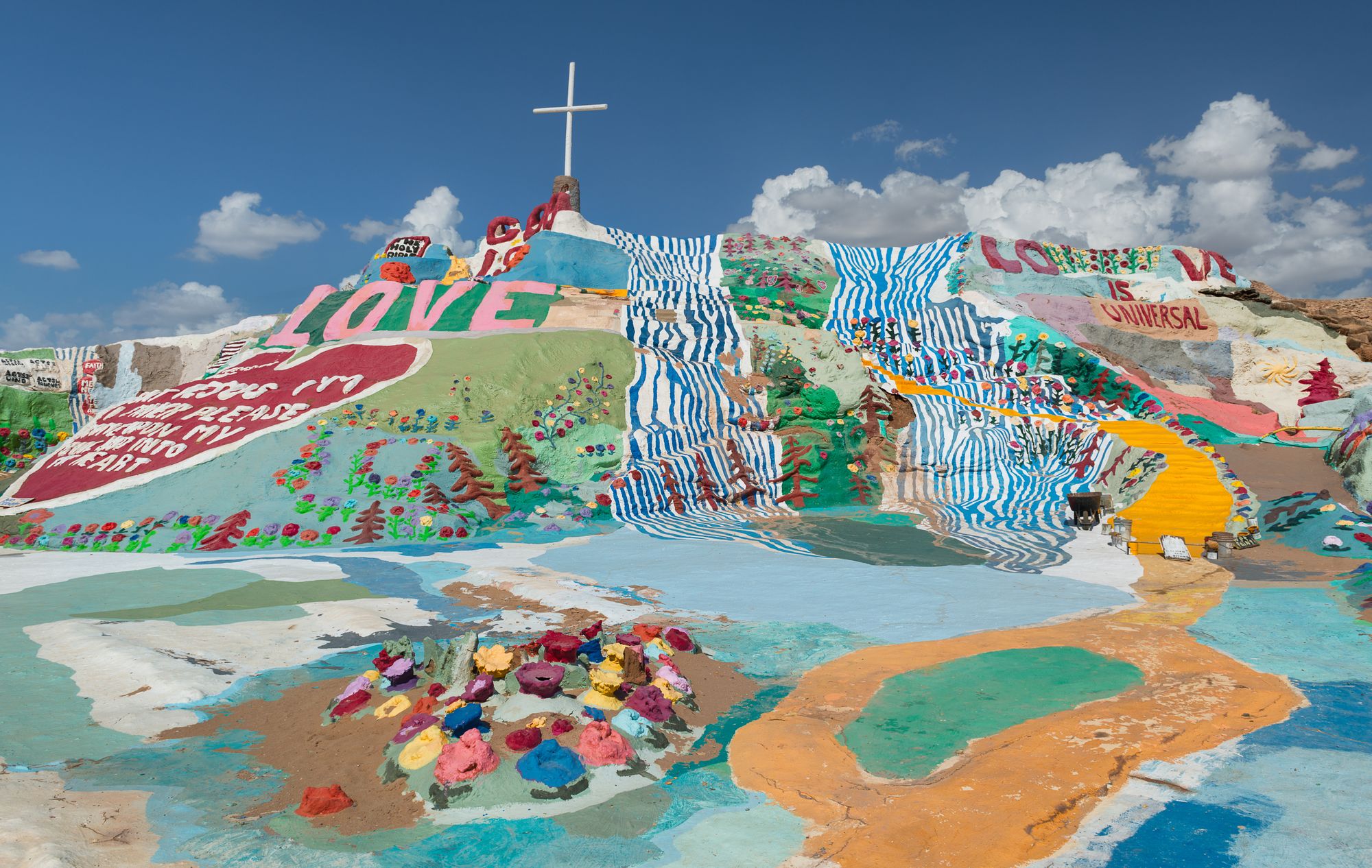
Salvation Mountain sits at the entrance and is the reason many visitors come at all. Leonard Knight spent decades painting a desert bluff into a hundred-foot-wide folk-art monument of straw, adobe, and donated paint, topped with the word GOD and covered in flowers and scripture. He lived on site in a truck for most of those years. Knight died in 2014; volunteers maintain the mountain now, and it remains one of the strangest and most sincere artworks in the country.
East Jesus, deeper into the Slabs, is the other landmark: an experimental art garden built from what the desert was given, which is to say garbage. A wall of dead televisions with painted screens, a mammoth made of tires, sculpture that rotates as artists come and go. It runs on donations and is walkable in under an hour.
The rest of the experience is the community itself: hand-painted signs, solar panels wired to school buses, a library, and an economy that runs on barter and ingenuity. Which is exactly why the visiting etiquette matters.
How to visit without being a jerk
Slab City photographs like a film set, but it's a town. People's homes are the scenery. The working rules: ask before photographing anyone or their place, buy something or donate where donation boxes exist, don't wander into camps uninvited, and drive slowly, because dust is currency out here and you're spending someone else's. Visitors who treat it like an open-air museum get a cold reception. Visitors who treat it like a small town do fine.
Camping at the Slabs
Camping is free, which is the founding idea of the whole place. Pick an unclaimed spot away from established camps, and be visibly self-contained: everything you need arrives with you, everything you produce leaves with you. There are no hookups, no dump station, no water fill. This is full boondocking, and it favours rigs with solar, decent battery capacity, and full fresh-water tanks.
If that's more self-sufficiency than you want, the practical alternative is to base somewhere with services and day-trip in. Developed campgrounds around the Salton Sea and in the Coachella Valley put you within an hour, with the state parks at Anza-Borrego another option to the west.
When to go
October through March. The winter desert is the entire reason the Slabs fill each year: warm days, cold clear nights, and some of the best stargazing in Southern California, since the nearest real light pollution is a long way off. Summer is not a scheduling inconvenience, it's a hazard; this corner of the desert runs past 110 degrees for weeks, and services do not exist to bail anyone out.
FAQ
Where is Slab City?
In the Sonoran Desert of Imperial County, California, about four miles east of Niland and near the eastern shore of the Salton Sea. From Palm Springs it's roughly a 90-minute drive south.
Is Slab City dangerous?
Mostly no, with an honest asterisk. Daytime visits to Salvation Mountain and East Jesus are routine tourist stops. Like any place with no services and some residents in hard circumstances, the usual travel judgment applies: visit the landmarks in daylight the first time, keep valuables out of sight, and be a guest rather than a spectator. The desert itself, especially summer heat, is the more reliable danger.
Does Slab City have laws?
It has no local government, no utilities, and no rent, but it isn't a legal void: it sits on California state land, and state and county law apply, with sheriff patrols passing through. "Lawless" makes better headlines than it does travel advice.
Can you camp for free at Slab City?
Yes. That's the point of the place. Bring everything, including your water and your patience, and take everything out. If you want hookups and showers, camp near the Salton Sea or in the Coachella Valley and visit for the day.

Team RVezy
Team RVezy is a group of RV enthusiasts who traverse the U.S. and Canada in our campervans, tiny trailers, and motorhomes. We love the open road and the feeling of having nowhere to go but everywhere.
View more posts